









Almond Milk for Hotel Breakfast & F&B Programs
August 14, 2026

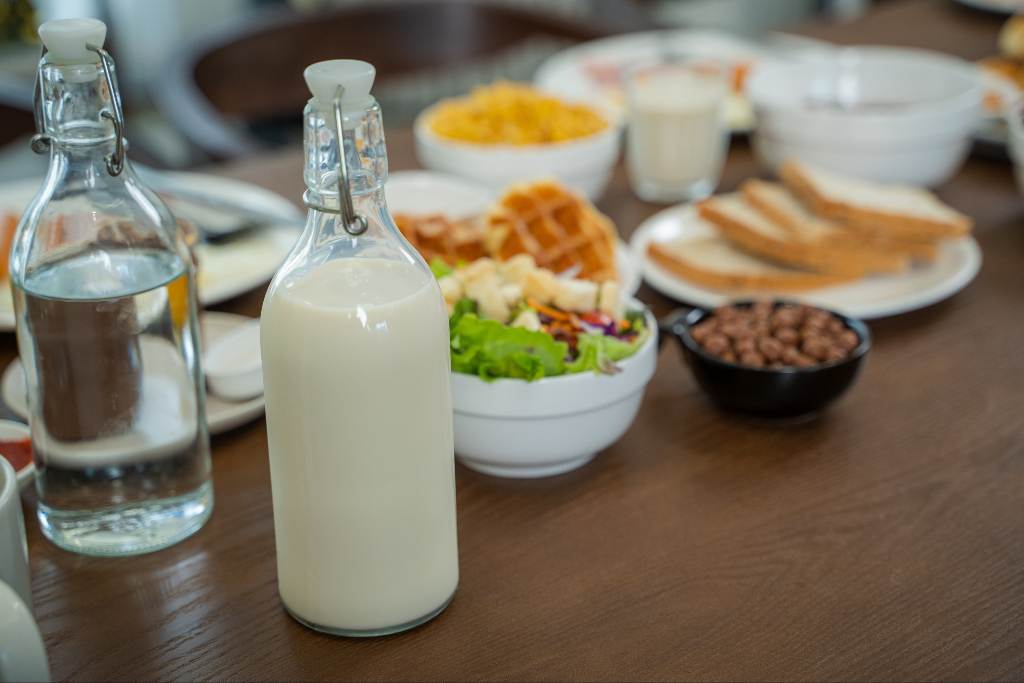
Almond milk is a standing item on most hotel breakfast programs. One carton covers vegan, lactose-intolerant, and calorie-conscious guests, pouring into drip coffee at the buffet, lattes at the lobby bar, and cereal or smoothies on the cold line. With that much ground to cover, the best almond milk for a hotel is a barista-formulated one that stays smooth in hot coffee, foams well for any server or barista, and keeps on a dry shelf until the carton is opened.
Beyond choosing the milk, keeping it consistent through a full breakfast rush comes down to how it’s stored, how much is on hand, and how it’s steamed. Operators building almond milk for foodservice programs make those same calls in every outlet.
What You’ll Find
- What Hotel F&B Programs Need From Almond Milk
- Almond Milk Across Hotel F&B Outlets
- How to Store Almond Milk in a High-Volume Kitchen
- How to Set Par Levels for Breakfast Service
- Almond Milk Steaming Temperature and Service Specs
- Almond Milk 2.0 in Hotel F&B Programs
- Put Almond Milk 2.0 on Your Breakfast Line
- FAQs
What Hotel F&B Programs Need From Almond Milk
A hotel pours almond milk through more hands than a café does, from guests at the buffet to banquet servers and baristas. The almond milk that holds up across all of them meets seven standards:
- Stability in drip coffee and espresso. Guests at a self-serve station pour cold almond milk straight into hot drip coffee, where the coffee’s heat and acidity can make it curdle in the cup. A milk that stays smooth there and in fresh espresso shots keeps flecked coffee off the buffet.
- Foam that holds without a trained barista. Not everyone steaming milk at a hotel is a trained barista. A forgiving almond milk builds stable microfoam across a range of technique and holds it on the way from the bar to the table.
- Body hot and cold. Full mouthfeel in a latte, over cereal, and in a smoothie, without a watery finish.
- A clean label for dietary requests. Vegan, dairy-free, and gluten-free with no added oils, covering the most common requests at the breakfast line with one carton.
- Shelf-stable aseptic cartons. Cartons that hold on a dry shelf until opened, in a size each outlet finishes inside the opened-carton window.
- Consistency case to case. The same flavor, body, and foam in every delivery, keeping a property’s steaming standard steady from one lot to the next.
- Supplier capacity. Volume that scales from sample cases to truckload across properties without a spec change.
Almond Milk Across Hotel F&B Outlets
Each outlet uses almond milk for different drinks and handles it in its own way.
| Outlet | Main use | Who pours | Handling |
| Breakfast buffet | Drip coffee, cereal, oatmeal, smoothies | Guests, from self-serve carafes | Chilled carafes swapped on a set schedule, allergen signage at the station |
| Lobby café or coffee bar | Lattes, cappuccinos, iced drinks | Baristas | Dedicated steaming pitchers, cartons pulled from the cooler as needed |
| Banquets and meeting breaks | Coffee service from airpots and carafes | Banquet staff and guests | Chilled pitchers beside the airpots, refreshed within the two-hour limit |
| In-room dining | Single pours with coffee or cereal | Room service attendants | Small pitchers portioned per order, dated opened cartons |
Running one almond milk specification across every outlet means staff learn one steaming standard and one storage routine, whichever station they work. The lobby coffee bar carries the heaviest steaming load of the four and runs much like a high-volume café.
Read: How Barista-Grade Almond Milk Performs in High-Volume Cafes
How to Store Almond Milk in a High-Volume Kitchen
Sealed aseptic cartons are shelf-stable at room temperature, so backstock holds on a dry shelf instead of taking refrigerator space. Once opened, a carton behaves like any fresh dairy product.
| Stage | Where it lives | Standard practice |
| Unopened cartons | Cool, dry ambient shelf | Rotate FIFO, check the date |
| Opened cartons | Refrigerated at or below 40°F (4°C) | Reseal, date, use within the supplier window |
| On the service line | Insulated pitcher or rail | Pour only what you’ll use, never leave it warm |
The FDA sets that 40°F ceiling for refrigerators and limits foods that need refrigeration to two hours at room temperature. Portioning into chilled pitchers keeps the service line inside that limit. A carton left on the line for a four-hour service falls outside safe holding practice, losing flavor and foam quality as it warms.
Date-labeling every opened carton keeps waste and quality complaints down. The same storage practices carry over to the rest of a plant-based program, including your non-dairy creamer options.
How to Set Par Levels for Breakfast Service
A par level protects both the menu and food cost, keeping almond milk available through the last cover without leaving opened cartons to spoil. It comes from four inputs: breakfast covers, the non-dairy share, pour size, and a buffer.
- Estimate breakfast covers. Room count times occupancy times guests per room times the share who eat on-site.
- Estimate the non-dairy share. Apply the percentage of orders likely to request a plant-based milk.
- Apply a per-serving pour. Budget 5 to 6 oz for a steamed latte, about 2 oz for drip.
- Add a buffer. Build in 10 to 20% for peaks and re-pours.
- Convert to cartons. Divide the daily ounces by the carton size (32 fl oz for a quart carton) and round up.
A 200-room property at 70% occupancy with 1.5 guests per room hosts about 210 guests a night. If 80% of them eat breakfast on-site, that comes to about 168 covers. With a quarter of those guests choosing non-dairy at a blended 4 oz across lattes and drip, the property uses about 168 oz a day. That rounds up to six quart cartons, or seven with a 20% buffer. Track real depletion for a week, then adjust. Properties that pour almond milk beyond breakfast set a separate par line for each outlet on the same order, keeping the lobby bar’s latte volume from drawing down the buffet’s supply.
Almond Milk Steaming Temperature and Service Specs
Steam almond milk to 140 to 150°F (60 to 65°C), the lower end of the range most bars use for dairy. Almond proteins tend to hold their structure in that window. Past about 160°F, the milk starts to scorch and the foam breaks down.
Steamed too hot: thin, soapy bubbles that fade fast, plus a cooked, bitter edge.
Steamed to spec: glossy microfoam that holds, a sweeter finish, and a stable canvas for latte art.
Chilled milk gives the steam wand a longer window to build texture before the milk reaches temperature. Between drinks, the almond milk pitcher goes back to the cooler rather than sitting on the bar. A dedicated almond milk pitcher, plus a purge and wipe of the steam wand after each drink, helps keep almond residue out of dairy orders for guests with tree-nut allergies.
For iced drinks, a higher-protein almond milk holds its body in cold foam and shaken drinks, keeping its layers intact in a tall glass.
Almond Milk 2.0 in Hotel F&B Programs
Many almond milks work in cereal but curdle or lose their foam in coffee. Harris Woolf Almonds developed Almond Milk 2.0 as a finished, ready-to-use almond milk for that coffee side of the menu, with specs that carry into daily hotel service:
- 45+ minute microfoam. Dense, silky foam that holds in hot and cold drinks.
- 3g of protein per serving. Protein that supports foam structure and body in the cup.
- 32 fl oz (1 qt) aseptic cartons. Shelf-stable until opened.
- Vegan, dairy-free, and gluten-free. Made with no added oils.
Almond Milk 2.0 won a 2025 Best New Product Award for Specialty Non-Coffee Beverage Standalone at the Houston Specialty Coffee Expo. We produce it in an SQF Certified operation as an independent, grower-owned, vertically integrated processor with 35 years of California almond partnerships. Hotel programs qualify Almond Milk 2.0 from a sample first, then order from pallets to truckload as they grow across properties.
Put Almond Milk 2.0 on Your Breakfast Line
For the guest who asks for almond milk, one cup is the part of breakfast built around their request. The almond milk in that cup needs to pour the same on the last refill of the buffet carafe as it did in the first latte of the morning.
At Harris Woolf Almonds, we see almond milk as a performance ingredient rather than a commodity line item. We work with hotel and foodservice teams as partners in their beverage programs, matching Almond Milk 2.0 to the way each outlet pours it.
Partner with Harris Woolf Almonds to put a barista-grade almond milk on your breakfast line. Request a sample today.
FAQs
What Is the Best Almond Milk for Hotel Breakfast and F&B Programs?
The best almond milk for hotel breakfast and F&B programs is a barista-formulated almond milk that stays stable in hot coffee, holds microfoam without a trained barista, and comes in shelf-stable cartons that fit foodservice storage. Almond Milk 2.0 from Harris Woolf Almonds meets that standard with microfoam that holds for 45 or more minutes, 3g of protein per serving, and 32 fl oz aseptic cartons. Hotels can request an Almond Milk 2.0 sample to qualify it on their own equipment.
Can One Almond Milk Cover Coffee, Cereal, and Smoothies at Breakfast?
One barista-formulated almond milk can cover all three. Milk built to steam and hold foam generally works just as well poured cold over cereal, stirred into overnight oats, or blended into a smoothie, letting one SKU serve both the coffee station and the cold line. Almond Milk 2.0 from Harris Woolf Almonds is made to perform in both hot and cold applications.
Does Almond Milk Need an Allergen Label at a Hotel Buffet?
Almond milk belongs on the allergen signage at any buffet or self-serve station because it is a tree-nut product. Tree nuts are one of the nine major food allergens named under U.S. food labeling law. A nut-free plant-based milk in its own labeled carafe gives guests with tree-nut allergies a safe option at the same station. For in-room dining, listing almond milk by name on the menu and the order ticket keeps the allergen visible to guests and to the staff preparing the tray.
How Should a Hotel Test Almond Milk Before Switching Suppliers?
Hotels get the clearest read on a new almond milk from a live service rather than a tasting. The trial runs the milk through espresso, the steam wand, an airpot at a meeting break, and a carafe that sits on the buffet for a full shift. Trialing at one outlet for a week before the rest lets a hotel switch almond milk suppliers without disrupting service while capturing real depletion and staff feedback.
How Do Hotel Groups Keep Almond Milk Consistent Across Properties?
Hotel groups keep almond milk consistent by naming one product in the group’s F&B standards rather than leaving the choice to each property. Each hotel then orders the same carton, trains staff to the same steaming temperature, and logs its own depletion against a shared par method. Reviewing those logs each quarter shows which properties are over- or under-ordering before waste builds up.